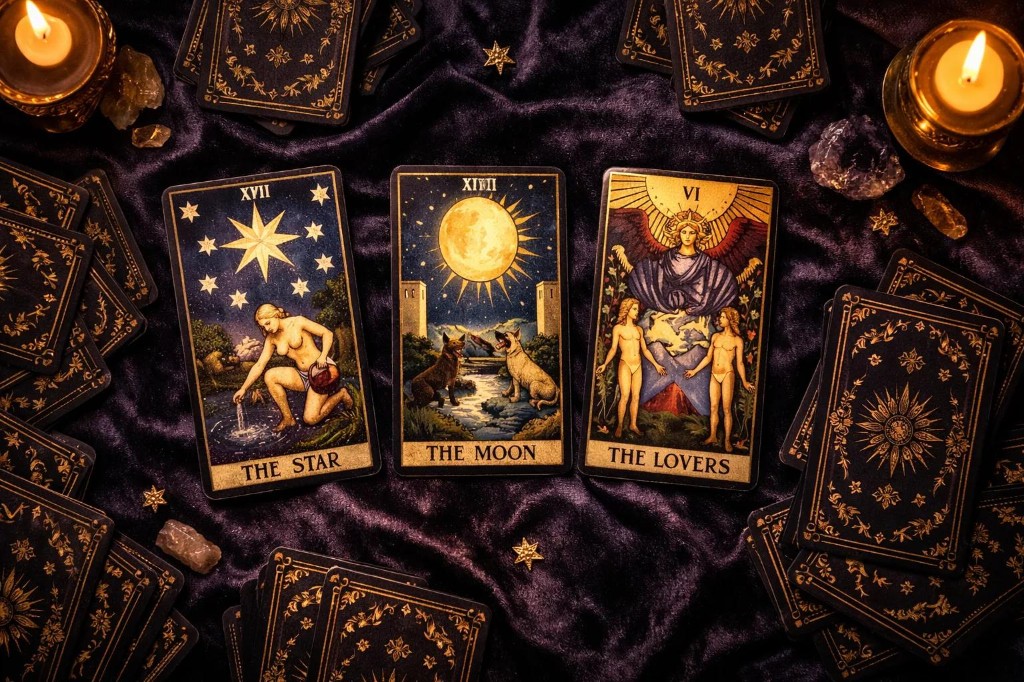
What is tarot reading?
Tarot is a deck of images that speak in symbols—78 cards, each pointing to a familiar life theme: choices, relationships, turning points, pressure, and growth. A draw does not lock in a fixed fate; it helps you see what you are feeling and asking more clearly.
On OmenDay you draw from the full deck free: One Card, Past·Present·Future, Love, Career, Yes/No lean, and Celtic Cross. Major Arcana mark turning points; Minor Arcana carry day-to-day weather across Cups, Wands, Swords, and Pentacles. Each card page lists upright, reversed, love, career, money, and spiritual notes.
How Tarot Reading Works
A tarot reading starts with a question. You shuffle the cards (or let the app shuffle them for you), then draw cards into specific positions in a spread. Each position has a meaning, such as the past, present, a challenge, or a possible next step.
A card's meaning depends on both the card itself and where it appears in the spread. For example, the same card may reveal something different in a love reading than in a career reading.
How to Choose a Tarot Spread
Choose a spread based on how much guidance you need. A simple spread works best for a focused question, while a larger spread helps you explore a more complicated situation.
One-Card Reading
Best for a quick answer, daily reflection, or a single decision. Focus on one clear question before drawing your card. The card offers one main idea to think about rather than a complete picture of your situation.
Past, Present & Future Tarot
This three-card spread looks at what has influenced you, where you are now, and what may come next. It's a simple way to understand how a situation is developing without using too many cards.
Love Tarot Reading
Explore your relationships, emotional needs, unspoken feelings, and possible challenges. Use the reading to reflect on your own choices and relationship patterns, rather than trying to control or predict another person's feelings.
Career Tarot Reading
Explore your current work situation, where your efforts are paying off, what obstacles may be holding you back, and what steps you could take next. The goal is practical guidance, not a fixed prediction of your career future.
Yes or No Tarot
A simple one-card reading for questions that seem to call for a yes or no answer. An upright card may suggest a more positive direction, while a reversed card may point to delays, uncertainty, or a need to reconsider. Treat the result as guidance, not a final decision.
Celtic Cross Tarot
A ten-card spread for exploring a more complicated situation. It looks at your current circumstances, main challenge, underlying influences, recent past, possible direction, and the people or circumstances surrounding you.
Learn About Tarot Cards
Major Arcana and Minor Arcana
The tarot deck contains 78 cards divided into two groups.
The Major Arcana has 22 cards, including The Fool, The Lovers, Death, and The World. These cards often represent major life themes, personal growth, and important turning points.
The Minor Arcana has 56 cards divided into four suits: Wands, Cups, Swords, and Pentacles. They reflect everyday experiences involving action, emotions, thoughts, relationships, and material life.
Upright and Reversed Cards
A tarot card can appear upright or reversed. An upright card generally expresses its main meaning more directly. A reversed card may suggest that the energy is blocked, delayed, turned inward, or expressed differently.
Reversed cards are not automatically negative. Their meaning depends on the card, the question, and its position in the spread.
How to Ask a Good Tarot Question
Clear questions lead to more useful readings.
Instead of asking, "Will everything work out?", try questions such as:
• What can I do to improve this situation? • What should I understand about my current relationship? • What is holding me back from reaching my career goals? • What pattern should I pay attention to?
Focus on your own choices and experiences rather than asking tarot to make medical, legal, or other high-stakes decisions for you.
How to Read Multiple Tarot Cards
When reading several cards together, start with the meaning of each position, then interpret the card in that position. Finally, look at how the cards connect.
For example, repeated suits may highlight a common theme. Cards with contrasting meanings may point to competing priorities. Later cards can add context to the earlier ones.
Reading the cards as a connected story often provides more useful insight than interpreting each card separately.
Explore All 78 Tarot Card Meanings
Explore all 78 tarot cards, including their upright and reversed meanings across love, career, money, and spiritual life.
Use the tarot card guide to understand the cards before or after your reading. Whether you are learning tarot for the first time or exploring a specific card, you'll find explanations to help you understand its symbolism and meaning.
Major Arcana
- The Fool
- The Magician
- The High Priestess
- The Empress
- The Emperor
- The Hierophant
- The Lovers
- The Chariot
- Strength
- The Hermit
- Wheel of Fortune
- Justice
- The Hanged Man
- Death
- Temperance
- The Devil
- The Tower
- The Star
- The Moon
- The Sun
- Judgement
- The World
Minor Arcana
- Ace of Wands
- Two of Wands
- Three of Wands
- Four of Wands
- Five of Wands
- Six of Wands
- Seven of Wands
- Eight of Wands
- Nine of Wands
- Ten of Wands
- Page of Wands
- Knight of Wands
- Queen of Wands
- King of Wands
- Ace of Cups
- Two of Cups
- Three of Cups
- Four of Cups
- Five of Cups
- Six of Cups
- Seven of Cups
- Eight of Cups
- Nine of Cups
- Ten of Cups
- Page of Cups
- Knight of Cups
- Queen of Cups
- King of Cups
- Ace of Swords
- Two of Swords
- Three of Swords
- Four of Swords
- Five of Swords
- Six of Swords
- Seven of Swords
- Eight of Swords
- Nine of Swords
- Ten of Swords
- Page of Swords
- Knight of Swords
- Queen of Swords
- King of Swords
- Ace of Pentacles
- Two of Pentacles
- Three of Pentacles
- Four of Pentacles
- Five of Pentacles
- Six of Pentacles
- Seven of Pentacles
- Eight of Pentacles
- Nine of Pentacles
- Ten of Pentacles
- Page of Pentacles
- Knight of Pentacles
- Queen of Pentacles
- King of Pentacles
How to ask a useful question
Strong prompts are specific and open. “What energy surrounds my job search this month?” works better than “Will I get the job?” After the draw, rewrite one line into an action you can finish today.
Upright and reversed
About one in four draws may reverse. Read the upright meaning first, then ask what feels stuck, private, or premature.
A simple tarot practice
Shuffle with your question in one sentence. Draw, read upright/reversed and domain notes, then journal three lines: what the cards name, what you already knew, and one deed for the next twenty-four hours.
Ethics
Do not use readings to stalk, guilt, or diagnose. Do not ask about medical outcomes or legal verdicts. If anxiety spikes, step away and talk to a trusted person. Pair situational questions with a Birth Chart or today’s Horoscope when you want longer context.