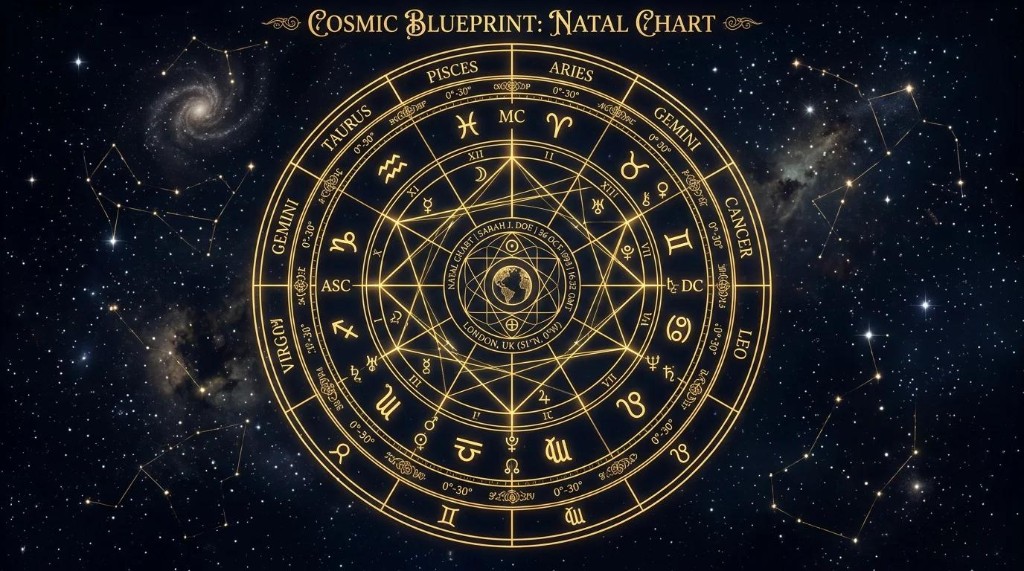
What is a birth chart?
A birth chart is a map of the sky at the moment you were born. The Sun, Moon, Rising, and other planets each speak to different parts of life—drive, emotion, relating, and how you move through the world. It helps you know yourself; it does not lock destiny.
On OmenDay, enter birth date, time, and city for a free natal chart: Sun, Moon, Rising, planetary placements, twelve houses, and major aspects—clear enough to read your rhythm and tendencies. The calculator is built for people searching a birth chart calculator who want readable results without an appointment. Positions come from ephemeris math for your birth moment and place; interpretive lines follow those placements instead of inventing degrees.
Four steps to calculate your natal chart
- Enter your birth date as recorded on an official document.
- Add birth time if you know it. Rising and house cusps move with the clock; without a time, treat Rising as approximate.
- Choose your birth city (or the nearest major city) so longitude and latitude can place the local sky.
- Generate the chart, then read Sun, Moon, and Rising first before diving into aspects and houses.
What a free result looks like
A typical free result names your Big Three and lists planetary signs—for example: Sun in Taurus, Moon in Virgo, Rising in Capricorn; Mercury in Aries; Venus in Gemini; Mars in Leo. Houses and major aspects (conjunction, square, trine, opposition, sextile) appear so you can see where ease and friction live. Save that first screen before you chase every minor contact. Premium deep reading expands the same calculated map into longer chapters; it does not invent new degrees.
How to read Sun, Moon, and Rising
Sun answers what fuels you when you are honest. Moon answers what soothes or rattles you in private. Rising answers how you enter a room and start projects. Venus, Mars, and Mercury add relating, drive, and thinking style. Houses show life areas; aspects show friction and ease. Start with one sentence for each of the Big Three before you chase every aspect line.
Big Three reading at a glance
Use this table as a quick map before you open every aspect line. The Big Three is the shortest honest summary of a natal chart: drive, private weather, and entrance style. Write one sentence for each row after you generate the chart, then decide whether houses and aspects add useful detail or only noise for today. If two rows feel loud and one feels quiet, start with the loud pair—most people over-read the quiet point first and miss the pattern they already live.
| Point | What it asks | Best used for | Without birth time |
|---|---|---|---|
| Sun | What fuels you when you are honest? | Core drive, public identity, the story you keep returning to | Usually stable from date alone; rare midnight cusp edge cases |
| Moon | What soothes or rattles you in private? | Emotional needs, home climate, how you recover | May shift a few degrees—or change sign—near a lunar ingress |
| Rising | How do you enter a room and start projects? | First impression, body language, house cusps | Provisional only—needs a reliable clock hour |
Planetary placements
Beyond the Big Three, Mercury names how you think and speak, Venus how you bond and value, Mars how you pursue and defend, Jupiter where you expand, Saturn where you build and feel pressure, and the outer planets (Uranus, Neptune, Pluto) mark longer generational weather that still colors personal charts when tightly aspected.
- Mercury — mind, speech, learning style
- Venus — affection, aesthetics, money comfort
- Mars — drive, anger, desire tempo
- Jupiter — growth, belief, opportunity tone
- Saturn — structure, duty, long effort
- Uranus / Neptune / Pluto — disruption, imagination, deep change (generational + personal when exact)
Twelve houses explained
Houses are life rooms. First is self and body; second resources; third siblings and short trips; fourth home and roots; fifth creativity and romance play; sixth work and health habits; seventh partners; eighth shared resources and intensity; ninth meaning and travel; tenth career and public role; eleventh friends and networks; twelfth solitude and unseen processes. Without birth time, house cusps are provisional—do not over-read them.
Planetary aspects explained
Aspects are angles between planets. Conjunction blends; opposition polarizes; square friction-forces growth; trine eases flow; sextile offers opportunity if you act. OmenDay lists major aspects from calculated positions—we do not invent degrees. Missing or uncertain birth time does not invent Rising aspects.
- Conjunction — fusion of themes
- Opposition — polarity that needs dialogue
- Square — productive friction
- Trine — ease that can become complacency
- Sextile — opportunity with effort
Birth chart interpretation angles
After you generate the chart, read in this order: personality drive (Sun), emotional nature (Moon), entrance style (Rising), love and relating (Venus + 7th), career and money (10th/2nd + Saturn/Jupiter), communication (Mercury), strengths (trines/sextiles), challenges (squares/oppositions). Write one sentence per angle—do not outsource judgment to a single paragraph.
Related astrology guides
Go deeper with Sun · Moon · Rising, Twelve Houses, Moon Sign · Rising Sign, and house primers in Knowledge.
How to use this calculator if you do not know your birth time
Many people search a free birth chart calculator without an exact birth hour. You can still use OmenDay productively. Enter the date and city you have; if the form needs a clock value, use noon as a clear placeholder and treat Rising as provisional. The Sun sign is almost always stable for the civil date. The Moon moves roughly thirteen degrees a day, so a missing hour can nudge Moon by a few degrees—or, near a sign change, into the neighboring sign. Rising and house cusps move with the clock; without a recorded time, skip house-based conclusions and any story that depends on Ascendant. Dig for a birth certificate, hospital record, or family memory before you rewrite identity around Rising. When you confirm a time later, recalculate once—do not stack competing Rising myths. Meanwhile, read planetary signs and major aspects that stay useful even with a soft clock, and hold house topics lightly. Pair the free result with a daily horoscope for calendar weather, and a tarot draw when you have a question-shaped decision. Unknown time is common; naming what is solid versus provisional is the useful skill—and it keeps this calculator honest for real searches.
Placidus houses and the tropical zodiac
OmenDay uses the tropical zodiac and Placidus houses by default—common in modern Western natal practice. Tropical signs follow the seasons; Placidus divides houses by time. Whole Sign houses assign one sign per house from the Rising sign. Neither system is “more true”; they emphasize different stories. If Rising feels wrong, confirm birth time before switching systems in your mind.
Birth data hygiene
Prefer official records for birth time. Small minute changes can rotate Rising. If your city is missing from the list, pick the nearest major city for now and note the approximation. Do not publish someone else’s chart without consent. When you share a chart with a partner or counselor, say whether the birth time is documented or estimated so Rising is not treated as hard fact. Charts describe symbolic weather—you still choose what to do.
Connect to other rooms
After you know the big three, pull a reflective tarotabout one chart theme, browse today’s horoscope, or explore Chinese zodiacand BaZi Four Pillars calculator. Charts describe symbolic weather—you still steer.